
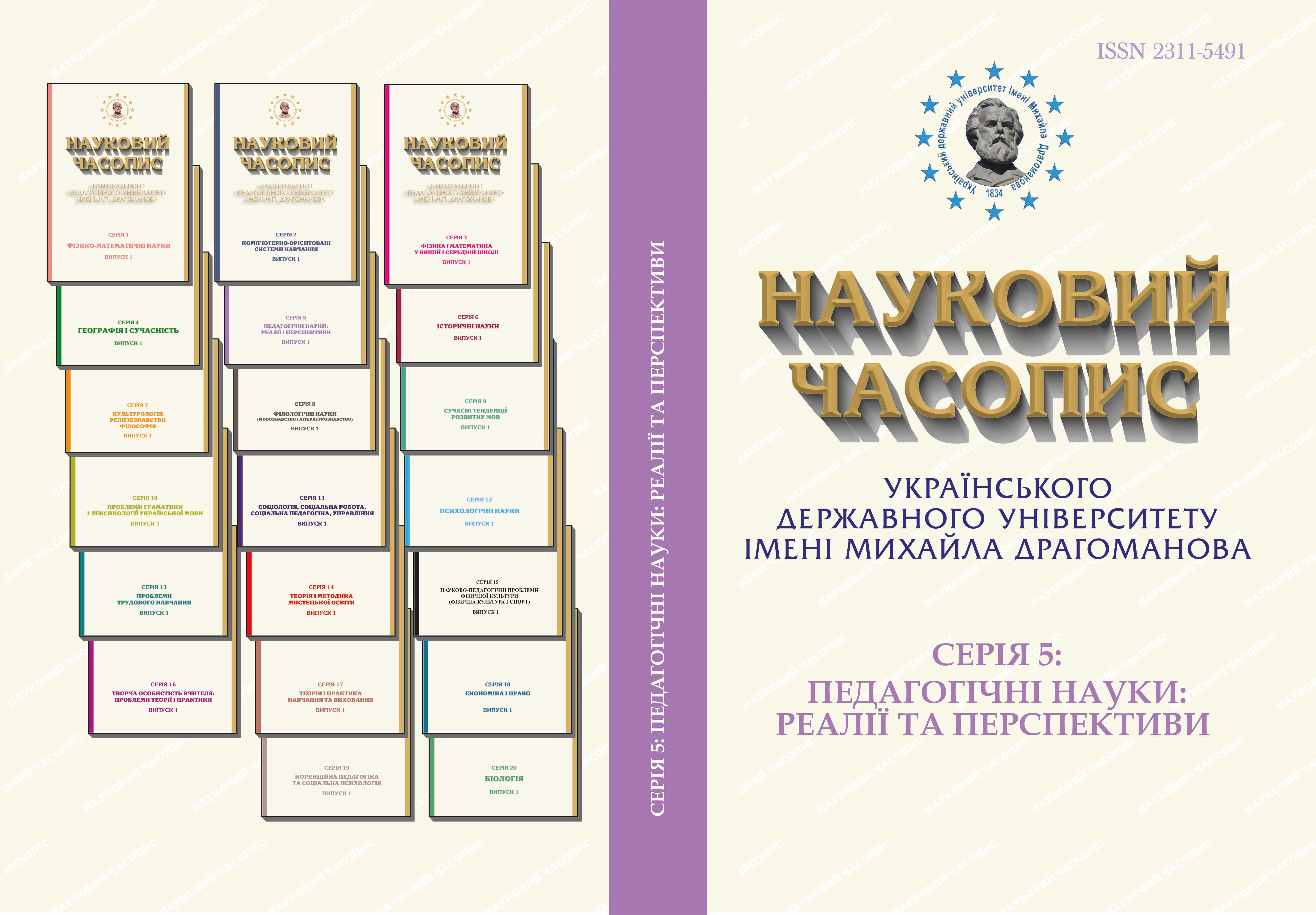
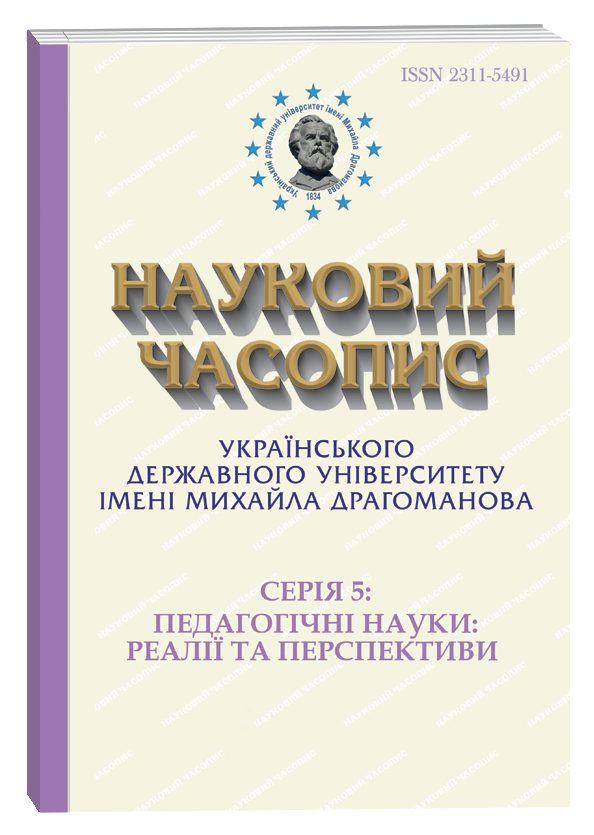





Naukowyi Chasopys Dragomanov Ukrainian State University. Series 5. Pedagogical sciences: reality and perspectives was founded in 2004 by M.P. Dragomanov National Pedagogical University (now - Dragomanov Ukrainian State University) on the initiative of the rector, academician V.P. Andrushchenko and the Vice-rector for scientific work, Professor G.I. Volynka.
ISSN: 3083-5690 online, 3083-5682 print
Registration in the National Council of Ukraine on Television and Radio Broadcasting: Extract from the register of entities in the field of media registrants. Media identifier R30-01411 (decision No. 932 dated 09/28/2023).
Media entity: Dragomanov Ukrainian State University (EDRPOU code 44807628, Pirogova str. 9, Kyiv, 01601, Этот адрес электронной почты защищён от спам-ботов. У вас должен быть включен JavaScript для просмотра., tel. (044) 234-11-08). ROR: https://ror.org/00batt813.
The journal is included in the List of Scientific Professional Publications of Ukraine in accordance with Order No. 928 of the Ministry of Education and Science of Ukraine dated June 11, 2026 (Appendix 14). The journal has been assigned Category “B” for three years, from June 1, 2026, to May 31, 2029.
Cluster: Human Capital Development, Social Sciences, and Journalism.
Specialties: A1 Education Sciences, A2 Pre-school Education, A3 Primary Education, A4 Secondary Education (with subject specializations, A5 Vocational Education (with specializations), A6 Special Education (with specializations), I10 Social Work and Counselling.
Due to the change of the name in the journal’s name, corresponding amendments were made to the List of Scientific and Professional Publications of Ukraine (Order of the Ministry of Education and Science of Ukraine No. 1543 of 12/20/2023 (Appendix 8)).
The scientific journal is included in the international scientometric database Index Copernicus International (The Republic of Poland), published on the VNLU (Vernadsky National Library of Ukraine) website.
Languages: Ukrainian, English, Spanish, Italian, German, Polish, Slovak, Hungarian, French, Czech.
The editorial board accepts individual articles submitted by postgraduate students enrolled in state-funded programs for publication free of charge, provided that the manuscripts are authored solely by the students (without co-authors), comply with the journal’s requirements, and adhere to the principles of academic integrity.
Frequency: 6 times a year.
Editorial address: Dragomanov Ukrainian State University, 01601, Kyiv, str. Pirogov, 9.
DOI: https://doi.org/10.31392/UDU-nc.series5
Publisher: Publishing House “Helvetica” (EDRPOU code 38044877; 65101, Ukraine, Odesa, 6/1 Inhlezi St; phone number: +38 (095) 934-48-28, +38 (097) 723-06-08; e-mail: Этот адрес электронной почты защищён от спам-ботов. У вас должен быть включен JavaScript для просмотра.; Publishing entity certificate: ДК No. 7623 as of 22.06.2022). Publisher's ROR: https://ror.org/0021ckm71.
The purpose of the academic journal is to disseminate the results of contemporary theoretical and applied research in the field of pedagogical sciences, to promote the development of educational theory and practice, to integrate Ukrainian pedagogical science into the international academic community, and to popularize innovative approaches to teaching, learning, and personal development in the context of modern societal transformations.
The main objectives of the academic journal are:
- to publish original research articles reflecting the results of актуальних studies in pedagogy and related disciplines;
- to highlight theoretical foundations and practical aspects of the development of preschool, primary, secondary, vocational, and special education;
- to analyze current pedagogical, psychological, and social issues in education and to identify ways of addressing them;
- to promote interdisciplinary research in the fields of education, social work, and youth services;
- to facilitate the implementation of research findings into educational practice and improve the quality of the educational process;
- to support scholarly communication between Ukrainian and international researchers;
- to disseminate advanced scientific experience and innovations in pedagogical science;
- to ensure adherence to high standards of academic integrity and quality of scholarly publications.
The series 5 reviews the results of theoretical research and experimental work on pedagogical science, discloses the pedagogical, psychological and social aspects that cause the actualization of the problem and help to solve it at the current stage of educational development.
The journal publishes articles by leading domestic and foreign scientists and promotes scientific research in the pedagogical sciences.
Editorial of the Naukowyi Chasopys Dragomanov Ukrainian State University. Series 5. Pedagogical sciences: reality and perspectives invites you to join the team of authors of the publication and to contribute to the development of scientific thought.
UDC 37.013(006)
________________________________________________________________________
Editorial Policy and Publication Ethics
Ethics guidelines of the editorial board are based on the recommendations of the Committee on Publication Ethics, International standards for editors and authors, and Ethical Code of Ukrainian Researcher.
The editorial board considers the monitoring of ethics of the manuscripts as one of the aspects of its activities and the peer-review process.
Editors don’t approve the materials which contain insulting statements, manifestations of aggression or any discrimination, or incite ethnic and racial hatred, violate international legal norms and current legislation of Ukraine.
Editors are not responsible for opinions, judgments, results and conclusions made by the authors of articles and published in the journal. They do not represent the point of view of the editorial board.
Editors are not liable to the authors and/or third parties and organizations for possible damage caused by the publication of the article.
The authors are responsible for the originality or any unfair use of the intellectual property of other authors, as well as for the reliability of information, the accuracy of names, surnames, etc.
Editors reserve the right to review the above ethical principles to amend them.
Ethical guidelines for editors
▶ editors take responsibility for everything they publish and thus, all submitted materials are subject to careful selection and peer review. Editors reserve the right to reject an article or send back for improving;
▶ editors should make fair and unbiased decisions independent from commercial consideration and ensure a fair and appropriate peer review process within a reasonable time;
▶ editors are entitled to reject a manuscript without peer-reviewing if it doesn’t meet the editorial policy, ethics and requirements for manuscripts;
▶ editors shall not provide information related to the content of a manuscript under consideration to other persons, except ones involved in the professional evaluation of this manuscript;
▶ editors are authorized to withdraw the electronic version of the article published in the printed version of the journal, if someone’s rights or generally accepted rules of scientific ethics are violated. The editors inform the author who provided the article and the organization where the work was performed about the fact of withdrawal of the article. Editors also publish a notice of the fact of withdrawal of the article in the next issue of the journal;
▶ editors allow distributing any articles or extracts from the journal in electronic social networks, but reference to the original source is mandatory. The third parties or organizations are prohibited to publish and / or distribute the journal materials in paper form and data storage devices.
Ethical guidelines for authors
▶ the research being reported should have been conducted in an ethical and responsible manner and should comply with all relevant legislation. Authors should mention dangerous manifestations and risks associated with the research;
▶ researchers should present their results clearly, honestly, and without fabrication, falsification or inappropriate data manipulation.
▶ researchers should adhere to publication requirements that submitted work is original, is not plagiarised, and has not been published elsewhere;
▶ a manuscript can involve scientifically grounded criticism of a paper of another researcher. The personal comments are not regarded as relevant;
▶ funding sources and relevant conflicts of interest should be disclosed. Authors should guarantee a lack of the contractual relations or
property considerations, which could influence the publication of information contained in a manuscript;
▶ authors should indicate the sources of cited information, which should be properly acknowledged and referenced.
Ethical guidelines for peer-reviews
▶ if an appointed peer-reviewer is not confident that his qualification meets the level of research, he/she should give the manuscript back immediately;
▶ a reviewer should be impartial when evaluating a manuscript, its experimental and theoretical parts, interpretation and statement, as well as take into account the correspondence of the research compliance with the high scientific and literature standards. The reviewer should respect the intellectual independence of authors.
▶ a reviewer should take into account a possibility of the conflict of interests if a particular manuscript closely relates to the reviewer’s current or published paper. If there are doubts, the reviewer should refuse to review the manuscripts referring to the conflict of interests;
▶ a reviewer should assess a manuscript if he/she has personal or professional relations and if such relations can influence the impartiality;
▶ a reviewer shouldn’t show a manuscript under review others or discuss it with colleagues, only if the reviewer needs professional advice;
▶ reviewers should adequately explain and justify their judgments so that editors and authors can understand the reasons their comments are based on;
▶ a reviewer should indicate any cases of a lack of citations of the papers of other scholars, any significant similarity between the relevant manuscript and any published article or any manuscript simultaneously submitted to another journal;
▶ a reviewer should provide a review without undue delay;
▶ reviewers should not use or disclose unpublished information, arguments, or interpretations contained in the manuscript without the consent of the author.
Adherence to the Principles of Responsible Research Assessment (DORA)
The Editorial Board of the journal supports the principles of the San Francisco Declaration on Research Assessment (DORA), which aim to improve practices for evaluating research outputs.
The journal recognizes that research results should be assessed primarily on the basis of their scientific content, methodological quality, originality, and significance, rather than on journal-level metrics or other aggregated bibliometric indicators.
In its editorial practice, the journal follows these approaches:
▶ Manuscripts are evaluated based on scientific quality, sound methodology, originality, and relevance of the research, regardless of the bibliometric indicators of the authors or the journals in which they have previously published.
▶ The Editorial Board does not use the journal impact factor or other journal-based metrics as the primary criterion for evaluating individual research articles.
▶ During the editorial and peer-review process, the journal recognizes the diversity of research outputs, including theoretical developments, methodological approaches, empirical studies, and other forms of scholarly contribution.
▶ The journal encourages research transparency, proper citation of sources, and responsible use of research metrics.
The Editorial Board encourages authors, reviewers, and members of the editorial council to adhere to the principles of responsible research assessment and to contribute to the development of an ethical and transparent scholarly communication environment.
Peer-review procedure
All manuscripts submitted to the editorial board of the journal undergo a peer-review procedure.
The journal adheres to a double-blind (anonymous) peer review process: reviewers are unaware of the authors’ personal data, and authors are unaware of the reviewers’ identities.
Manuscripts submitted to the editorial office are checked for compliance with the requirements specified in the “Conditions” section. Only manuscripts prepared in accordance with the “Requirements for execution” and that have passed the initial editorial screening and copyright verification are admitted to the peer-review stage.
The Editor-in-Chief conducts the initial evaluation of the manuscript. In cases where the Editor-in-Chief has a conflict of interest (is the author or co-author of the manuscript, or has family or professional relations with the authors), the peer-review process is handled by another member of the editorial board who has no conflict of interest. Manuscripts must correspond to the scope of the journal. If the publication requirements are met, the manuscript is assigned a registration code and all information about the authors is removed.
The anonymous manuscript is then sent by email to:
- a member of the editorial board responsible for the relevant academic field of the manuscript;
- two external experts (reviewers).
External reviewers include Ukrainian and international Doctors of Sciences specializing in the same scientific field as the authors of the manuscript. On behalf of the editorial office, such scholars receive an invitation letter requesting a review. The email includes the anonymous manuscript and a standard review form. Reviewers must not be affiliated with the same institution as the author and must not have any conflict of interest.
During the peer-review process, reviewers evaluate the following aspects:
- correspondence of the article’s content to the topic stated in the title;
- relevance and originality of the scientific problem addressed in the article;
- justification of the practical significance of the conducted research;
- value of the article for a broad readership.
Reviewers complete a standard review form and choose one of the following recommendations:
- recommend the article for publication;
- recommend the article for publication after minor revisions;
- recommend the article for publication after major revisions;
- do not recommend the article for publication.
If reviewers recommend rejection or revision, they must provide a written, reasoned explanation for their decision. Reviews signed with either a handwritten or electronic signature are stored in the editorial office for three years from the date of publication of the journal issue in which the reviewed article appeared.
The decision of the editorial board is communicated to the authors. Manuscripts requiring revision are returned to the authors together with the review text without indicating the reviewers’ identities. The revised version of the manuscript is submitted for re-review, during which reviewers may request additional revisions. Revisions do not guarantee acceptance; if reviewers consider the changes insufficient, the manuscript will be rejected.
The Editor-in-Chief analyzes the reviewers’ reports and makes the final decision on publication based on their recommendations, arguments, and the manuscript’s compliance with the journal’s requirements. The Editor-in-Chief does not participate in decision-making regarding manuscripts authored by themselves, members of their family, or colleagues, or in cases where they have a personal interest. Such manuscripts undergo independent peer review without the involvement of the editor or their research group. The final decision regarding these manuscripts is made by the Deputy Editor-in-Chief.
Peer-review period: 2–4 weeks.
Retraction Policy
The Editorial Board adheres to the principles of academic integrity, publication ethics, and international standards of scholarly communication, in particular the recommendations of COPE (Committee on Publication Ethics). Retraction of an article is considered an exceptional measure applied to ensure the reliability of the scholarly record and to inform readers about substantial violations that affect the results or conclusions of the research.
Grounds for retraction may include confirmed cases of plagiarism or self-plagiarism, fabrication or falsification of data, significant errors that render the findings unreliable, duplicate publication, copyright infringement, undisclosed conflicts of interest, or other serious violations of the journal’s editorial policies and ethical standards. The procedure may be initiated by authors, members of the editorial board, reviewers, readers, or the institutions with which the authors are affiliated.
Upon receiving such information, the Editorial Board conducts a preliminary assessment and, where necessary, carries out an internal investigation involving members of the editorial board or independent experts. The authors of the article are informed of the concerns raised and are given the opportunity to provide explanations. Following the review, the Editorial Board may decide that no action is required, issue a correction, publish an expression of concern, or retract the article.
If a decision to retract is made, the journal publishes an official retraction notice indicating the reasons for the retraction and the date of the decision. The retracted article is not removed from the journal’s electronic archive; however, it is clearly marked as retracted to ensure transparency and preserve the integrity of the scholarly record. All decisions are made in accordance with the principles of fairness, confidentiality, and respect for the rights of all parties involved in the publication process.
Statement on the Use of Generative AI (GenAI)
The journal recognizes the growing role of generative artificial intelligence (GenAI) tools, such as ChatGPT, Bard, or Claude, in academic research and scholarly writing. We support the responsible and transparent use of such tools in accordance with international ethical standards and publishing guidelines.
GenAI tools cannot be listed as authors. Only human researchers can take responsibility for the integrity, originality, and accuracy of a submitted manuscript. Authors are fully accountable for all content, including any material generated with the help of AI tools.
GenAI may be used to support language editing, improve clarity, or assist in literature reviews. However, its use must not replace critical thinking, data interpretation, or scientific reasoning, which are the foundations of scholarly research.
If GenAI tools were used at any stage of manuscript preparation, authors must explicitly disclose this in the “Acknowledgments” or a dedicated section of the manuscript. A sample disclosure:
"Portions of this manuscript were supported by the use of generative AI tools to assist with language editing and text refinement. All content was reviewed and verified by the authors."
Authors must not use GenAI to generate, fabricate, or alter data, references, or findings. Submissions found to rely on AI-generated data without verification or transparency will be rejected or retracted.
The editorial board follows COPE’s guidance on AI use in research publishing and reserves the right to request original data or explanations from authors concerning their use of GenAI. Misuse of AI tools will be treated as a potential breach of research ethics.
Policy on Ethical Approval of Research Involving Human Participants
The academic journal adheres to the requirements of the current legislation of Ukraine and international ethical standards governing the conduct of research involving human participants, the use of personal or confidential data, biological materials, or research involving animals.
If a study submitted for publication falls under the scope of Ukrainian legislation on bioethics, personal data protection, or other relevant regulatory acts, authors are required to provide confirmation of approval obtained from an authorized body, in particular an ethics (bioethics) committee or another competent authority of the institution.
For research involving human participants, authors must ensure compliance with the principles of voluntary informed consent, confidentiality, anonymity, and the prevention of harm to research participants. In cases involving the collection and processing of personal data, compliance with the legislation of Ukraine on personal data protection must be ensured.
The Editorial Board reserves the right to request additional documents from authors confirming compliance with ethical standards and legal requirements, as well as to reject manuscripts that fail to meet these standards.
Consideration of Complaints Regarding Violations of Academic Integrity and Publication Ethics
The Editorial Board adheres to the principles of academic integrity, objectivity, impartiality, and transparency in its publishing activities. All complaints concerning possible violations of publication ethics are handled responsibly and confidentially.
Grounds for submitting a complaint may include suspected plagiarism, self-plagiarism, fabrication or falsification of data, copyright infringement, improper authorship practices, undeclared conflicts of interest, or unethical conduct during the peer-review or editorial process.
Complaints must be submitted to the Editorial Board in writing through the official communication channels indicated on the journal’s website. A complaint should include a clear description of the alleged violation, references to the relevant publication or materials, supporting evidence (if available), and the complainant’s contact details.
Upon receipt of a complaint, the Editorial Board conducts a preliminary assessment of its validity and, if necessary, initiates an internal investigation involving members of the Editorial Board and/or independent experts. The parties concerned are given an opportunity to provide explanations. The review process is conducted in accordance with the principles of impartiality and confidentiality.
Based on the results of the investigation, the Editorial Board adopts a reasoned decision, which may include confirmation of no violation, a request for corrections, rejection of the manuscript, retraction of a published article, or other appropriate measures depending on the nature of the violation. The parties concerned are informed of the outcome, subject to personal data protection and confidentiality requirements.
Open Access Policy, Copyright and Licensing
Naukowyi Chasopys Dragomanov Ukrainian State University. Series 5. Pedagogical sciences: reality and perspectives provides immediate open access to its content foolowing the principle that making research freely available to the public supports a greater global exchange of knowledge. Full-text access to scientific articles of the journal is presented on the official website in the Archives section.
This is in accordance with the BOAI definition of open access. The licensing policy is compatible with the overwhelming majority of open access and archiving policies.
It is an open access journal, which means all its content is freely available without charge to the user or his/her institution. Users are allowed to read, download, copy, distribute, print, search, or link to the full texts of the articles, or use them for any other lawful purpose, without asking prior permission from the publisher or the author as long as they cite the source. The journal is licensed by Creative Commons Attribution International CC-BY.


Archiving and Long-Term Preservation Policy
The journal ensures reliable and long-term preservation of all published materials in accordance with international digital archiving standards.
To safeguard scientific content:
all journal issues are archived in the V. I. Vernadsky National Library of Ukraine;
articles are deposited in the institutional repositories of universities collaborating with the authors.
Each published article:
is permanently available on the journal website without time limitations;
has a unique DOI (Digital Object Identifier), ensuring stable and long-term access.
Open Data Policy
The journal encourages authors to deposit all data supporting the results of their research in open repositories (institutional, national, or international), in line with FAIR principles. A DOI or other persistent data identifier should be provided in the article metadata and/or in the Data Availability section.